

IPFS Pinning Provider Status: Who's Still Shipping in 2026
Five of eight major IPFS providers hit discontinuities in the last 18 months. Here's what still ships, what shut down, and the migration path for each.
 by Nacho Coll
Nacho founded IPFS.NINJA to make content-addressed storage feel as simple as an S3 PUT — a single API call, a permanent CID, no wallets or peer discovery to reason about.
- Infura IPFS shut down 2026-08-15. Fleek IPFS discontinued 2026-01-31.
- Storj filed Chapter 11 on 2026-07-26. Network still runs; future is unknowable.
- Web3.Storage rebranded to Storacha; NFT.Storage retired the free tier in 2024.
- Pinata, Filebase, Lighthouse, 4EVERLAND, and IPFS.NINJA are still shipping.
As of August 2026, five of the eight IPFS providers most developers had bookmarked two years ago have hit a discontinuity: Infura IPFS shut down on 2026-08-15, Storj Labs filed Chapter 11 on 2026-07-26, Fleek discontinued its IPFS hosting on 2026-01-31, NFT.Storage retired the free tier in 2024, and Web3.Storage rebranded to Storacha with the old endpoints deprecated. IPFS the protocol is fine — CIDs are still portable, gateways still resolve, the network still works. Pinning is the layer where the ecosystem thinned.
Here’s what changed at each provider, what still works, and — if you need to move — the concrete migration path we’ve documented.
Quick verdict — status of every major IPFS provider#
| Provider | Status (2026-08-27) | What to do |
|---|---|---|
| Infura IPFS | Shut down 2026-08-15 | Migrate immediately. Uploads stopped 2026-08-03; gateway is offline. |
| Storj | Chapter 11 filed 2026-07-26 | Network runs, but back up proactively and evaluate alternatives. |
| Fleek IPFS | Discontinued 2026-01-31 | Migrate. The IPFS hosting product is gone. |
| Web3.Storage | Rebranded to Storacha | Old endpoints deprecated. Reassess Storacha’s w3up model or migrate. |
| NFT.Storage | Free tier retired 2024 | Paid product exists at per-GB pricing. Decide whether to pay or move. |
| 4EVERLAND | Still shipping, pivoting to AI/DePIN | Fine if that direction fits your stack. Compare cost. |
| Pinata | Still shipping, focusing on AI agents | Fine to continue. Reasonable to benchmark cost against alternatives. |
| Lighthouse | Still shipping | Reasonable choice for Filecoin-anchored permanence use cases. |
| Filebase | Still shipping | Good fit if you want S3-native ergonomics. |
| IPFS.NINJA | Still shipping. Monthly product changes. | Ours. Honest self-placement — details below. |
The rest of this post explains each row so you can make a call for your own stack.
What actually happened at each provider#
Infura IPFS — shut down 2026-08-15#
Consensys ran the shutdown in two phases. On 2026-08-03 uploads were disabled (/api/v0/add returned 403 while existing pins continued to resolve). On 2026-08-15 the full service went offline: pinning API, dedicated gateways (*.infura-ipfs.io), and dashboard writes all stopped responding.
What still works. Your CIDs are still valid identifiers — a CID is a hash of the content, not a pointer to Infura’s servers. If the same content is pinned anywhere else on the network, it still resolves. What you can no longer do is upload new content, list your historical pins through Infura’s API, or serve traffic through <slug>.infura-ipfs.io hostnames.
Severity: high. If any part of your app still references an infura-ipfs.io URL, it’s returning errors to real users right now. A single Consensys announcement doesn’t get you off the hook — you have to re-pin your CIDs somewhere and swap your gateway URLs. Full runbook: Migrate from Infura IPFS after shutdown.
Storj — Chapter 11 filed 2026-07-26#
Storj Labs filed for Chapter 11 bankruptcy protection on 2026-07-26, according to Coindesk and Crowdfund Insider. Chapter 11 is a reorganization filing, not a shutdown — the network is still running as of publish, access grants still work, existing buckets still serve.
What still works. Uplink CLI reads and writes, S3 gateway, existing edge nodes. Nothing on the operator side has been cut.
Severity: medium — but the risk shape changed. The uncertainty isn’t “will Storj be down tomorrow” — it’s “who’s operating this in six months, and under what terms.” That’s a fair question for any dependency, but for a data-persistence layer it’s the wrong kind of uncertainty. If you’re storing data you can’t re-source, you want a backup somewhere the operator’s balance sheet isn’t the story. If Storj is on your critical path, mirror the data now while access grants still work. Full runbook: Storj Chapter 11 — move your data off.
Fleek IPFS — discontinued 2026-01-31#
Fleek discontinued its IPFS hosting product on 2026-01-31. The parent platform pivoted toward AI-agent infrastructure over the course of 2025 and 2026; the classic Fleek IPFS Hosting page is no longer part of the product surface.
What still works. If you deployed a static site to Fleek IPFS Hosting historically, the CIDs from those builds are still valid IPFS content identifiers. If anyone is pinning them (you, another provider, or someone in the DHT), they still resolve. What’s gone is the ability to trigger new builds through Fleek’s IPFS product and the automatic pinning that used to come with each deploy.
Severity: medium. The migration is a normal “move your pinning somewhere else” — re-pin the CIDs that matter, swap any Fleek gateway URLs, done. Static-site builds themselves can be triggered from any CI runner; the pinning target is the only piece you need to replace.
NFT.Storage — free tier retired 2024#
NFT.Storage Classic stopped accepting new uploads on 2024-06-30. The service had positioned itself as a free public good for NFT metadata; the shift to paid was a substantive change in what the product promised. The successor product still exists and charges roughly $4.99/GB using an on-chain endowment model, which funds long-term Filecoin storage deals.
What still works. Historical content that was pinned during the free-tier era is still on the network — Protocol Labs kept the Filecoin deals for that data live. What no longer works is uploading new NFT metadata for free. If your minting pipeline still calls api.nft.storage/upload on the assumption it’s zero-cost, that assumption is 18 months out of date.
Severity: low to medium, depending on your workflow. If you already migrated to the paid product, you’re fine. If your team quietly kept a pipeline pointed at the free-tier endpoint after the deprecation, it’s producing errors now — audit for it.
Migration path. We wrote a full runbook for NFT teams moving off the free tier: NFT.Storage free-tier gone: what NFT devs actually do now — it walks through recovering CIDs from tokenURI events, re-pinning metadata + image CIDs, and verifying every token resolves end-to-end.
Web3.Storage → Storacha rebrand#
Web3.Storage completed its rebrand to Storacha and moved to a UCAN-capability-based (w3up) architecture. The old web3.storage API endpoints are deprecated in favor of the new Storacha CLI, w3up client, and capability-delegated auth model. Storacha is fully open source and Protocol-Labs-adjacent, which is a fair credential; the architectural discontinuity is what’s real here.
What still works. New uploads through the Storacha stack. Filecoin deals for the content that was uploaded historically. The CIDs themselves.
Severity: medium. This is an architectural discontinuity more than a shutdown — code that was written against web3.storage-era endpoints needs to be rewritten against w3up, and the auth model is UCAN-based (delegated capabilities) rather than API-key-based. That’s a good design choice but not a drop-in swap. If you’re deciding whether to invest in that migration or move to a different provider, the Storacha migration guide walks through both paths.
Providers that are still shipping — but pivoting#
Two names on the list are still fully operational but have visibly redirected their product focus. Neither is a reason to move, but they’re context worth reading.
Pinata — still shipping, focus is on AI agents#
Pinata is the most established IPFS pinning provider and remains fully operational. Reading their public blog through 2026, roughly seven in ten posts are about their AI-agent product line rather than IPFS. That’s a reasonable strategic choice — the AI market is where new customers are — but if you’re a pure-IPFS customer, the signal is that IPFS is no longer the fastest-moving part of the product.
What to do. Nothing urgent. If you like Pinata’s stability and are comfortable with the pricing (Free tier at 1 GB / 500 files, then $20/mo for the Picnic tier), continuing to use them is a reasonable call. If you’re evaluating cost, we’ve written a Pinata to IPFS.NINJA migration guide that walks through the swap.
4EVERLAND — still shipping, pivoting to AI and DePIN#
4EVERLAND has expanded well beyond IPFS pinning into AI compute and broader DePIN infrastructure. IPFS pinning remains available and functional. If the DePIN framing matches how you think about your stack, that’s a plus; if you just want a boring pinning service, the surface area to reason about has grown.
What to do. Nothing urgent. Evaluate cost and match against your actual constraints.
Providers still shipping without a visible pivot#
Three names on the list are running an IPFS-focused product without a rebrand or refactor to announce.
- Filebase — S3-compatible API, multi-network pinning (IPFS + Sia + Storj), 5 GB free tier. Solid choice if you want to swap S3 clients directly.
- Lighthouse — Filecoin-anchored permanence with pay-once pricing and Kavach threshold encryption. Good fit for archival and encryption-first use cases.
- IPFS.NINJA — our service. Details below.
What IPFS.NINJA offers, factually#
Since this is a post about who’s still shipping, it’s fair to put our own product on the record with the same directness as the rows above.
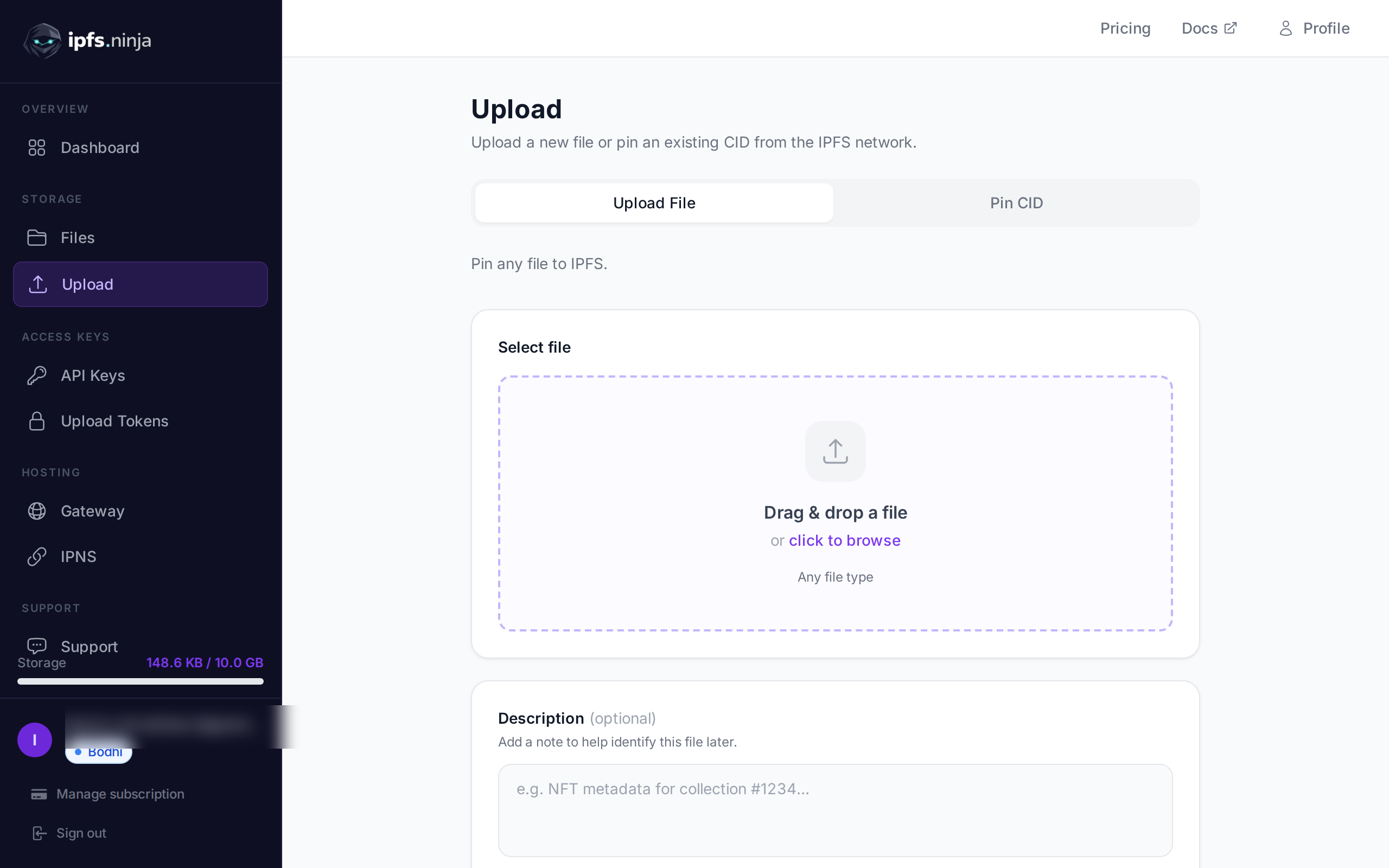
- 7-day trial, no credit card. Full Bodhi capacity during the trial: 10 GB storage, unlimited files, 20 GB monthly bandwidth, 1 dedicated gateway, 1 IPNS key, 3 API keys.
- Bodhi $5/mo — same limits as the trial. Karma $19/mo — 100 GB storage, 100 GB bandwidth. Nirvana $59/mo — 1 TB storage, 500 GB bandwidth, unlimited files.
- REST API for uploads and pinning. S3-compatible endpoint for teams already using S3 clients. CAR import for bulk migrations. IPNS for mutable names. MCP server for AI agents.
- Dedicated gateway on every paid plan, with per-key access controls and analytics.
If you don’t upgrade after the trial, your account transitions to a 30-day read-only state — pinned CIDs continue to serve through the gateway during that window, and re-subscribing at any point resumes uploads.
Details on pricing and signup.
How we think about stability#
This is the part where the pattern of the last 18 months matters. Five providers on the list above had a material change in their availability, ownership, or business model. That’s a lot of change for a category that’s supposed to be a boring layer under your app. It’s worth being honest about why some providers are more exposed to that kind of change than others.
We’re not a token. There’s no treasury denominated in a coin that has to trade above $X for the lights to stay on. Our funding is monthly subscription revenue from customers who are paying us to keep their content pinned. It scales with usage — if we do the job, more people pay us to keep doing it. If we don’t, we shrink. That’s boring on purpose.
We’re not a startup that raised on a decentralization narrative and now has to keep the narrative fresh to raise the next round. We’re a paid SaaS. Small enough that support tickets get replies from me directly. Boring enough that the roadmap is monthly product releases, not weekly pivots.
We ship monthly product changes with a public roadmap. Recent releases include unlimited files on Bodhi (2026-08-26), the MCP server for AI agents, an S3-compatible endpoint, and CAR import for bulk migrations. Nothing on our roadmap involves pivoting the product to a different market, rebranding, or restructuring the company.
Is any of that a guarantee? No. Nothing in tech is. A paid SaaS can still misjudge a market or run out of runway. What I can honestly claim is that the risk profile is different from a provider whose survival depends on a token price, or a company that has already announced a strategic pivot away from IPFS. If you want a longer read on that, our about page is where I put the longer version.
How to think about IPFS provider risk#
Whether you stay on your current provider or move, the framing that helped our customers most through the last 18 months is this:
Pinning is a service. IPFS is a protocol. Your CIDs are portable across any pinning provider — that’s the entire point of content addressing. If Infura shuts down, your CIDs don’t become invalid. They just need something on the network to still be serving them. Re-pin somewhere else and your ipfs:// URIs, ENS contenthash records, and NFT tokenURIs keep resolving without any smart-contract change.
Multi-pin is a legitimate strategy. Many production teams pin critical CIDs to two providers for redundancy. The extra cost is one additional monthly subscription; the benefit is that any single provider’s outage becomes a non-event for your users. If your product is important enough to warrant an SLA conversation, multi-pin is cheap insurance.
Back up your CID list. The failure mode that hits hardest during a provider shutdown isn’t the data — it’s losing the ability to enumerate what you had. Every provider we know of lets you export a pin list from the dashboard or the API. Do that on a schedule and keep the file somewhere you control (git, S3, a laptop). If the dashboard goes read-only or dark, your future self will thank you.
Evaluate on your actual constraints. Reliability, egress cost, gateway performance, developer ergonomics, IPNS support, access controls, S3 compatibility. Those are the axes that matter. Provider narrative — the pitch, the branding, the roadmap talk — matters less than what the numbers say when you exercise the endpoint at your traffic profile.
Closing — this post is a hub#
If your provider is on the “migrate” side of the table above, we’ve written a runbook for each of the discontinuities that got a lot of tickets in our inbox:
- Infura IPFS — Migrate from Infura IPFS after shutdown
- Storj — Storj Chapter 11: move your data off
- Web3.Storage / Storacha — Migrating from Web3.Storage to IPFS.NINJA
- Pinata (if you’re switching for cost) — Pinata to IPFS.NINJA migration guide
- Broader comparison — Best IPFS pinning services in 2026
If your situation isn’t covered by one of those — Fleek IPFS, NFT.Storage classic, a self-hosted Kubo cluster, an internal fork of one of the deprecated stacks — reply to hello@ipfs.ninja and tell us what you’re moving off. We answer support tickets ourselves; if the answer is “you shouldn’t move to IPFS.NINJA for what you’re doing,” we’ll tell you that too, and probably point you at whichever provider on the list above is the right fit for the constraints you named.
Ready to start pinning? Start your 7-day trial — full Bodhi capacity (10 GB / unlimited files / 20 GB bandwidth / 1 dedicated gateway). No credit card required. Then Bodhi $5/mo, Karma $19/mo, or Nirvana $59/mo.
About the author
Nacho Coll
Founder & Engineer at IPFS.NINJA
Nacho founded IPFS.NINJA to make content-addressed storage feel as simple as an S3 PUT — a single API call, a permanent CID, no wallets or peer discovery to reason about. Writes about IPFS internals, decentralized storage patterns, and the pinning-service landscape from the operator side of the wire.