English
English
Appearance
Upload your first file to IPFS in under two minutes.
Sign up at ipfs.ninja with your Google account to start your 7-day trial with full Bodhi capacity (10 GB storage, 200 files, 20 GB bandwidth, 1 dedicated gateway, 1 IPNS key, 3 API keys). No credit card required. A default API key is created automatically. Go to your Profile page to view and manage your API keys.
INFO
After the 7 days, choose a paid plan (Bodhi $5/mo, Karma $19/mo, Nirvana $59/mo) or your account transitions to a read-only state for 30 days — pinned CIDs continue serving through the gateway during that window. Re-subscribe at any time to resume uploads. See the Terms of Service for the full post-trial policy.
WARNING
Note: API keys don't expire. You can create multiple keys and revoke them individually from your Profile page.
Send a POST request to /upload/new with your content. Here's an example uploading a JSON object:
curl -X POST https://api.ipfs.ninja/upload/new \
  -H "X-Api-Key: bws_your_api_key_here" \
  -H "Content-Type: application/json" \
  -d '{
    "content": {
      "name": "My NFT",
      "description": "A permanent file on IPFS",
      "image": "ipfs://bafybeiExampleCID..."
    },
    "description": "NFT metadata"
}'const response = await fetch("https://api.ipfs.ninja/upload/new", {
method: "POST",
headers: {
"X-Api-Key": "bws_your_api_key_here",
"Content-Type": "application/json"
},
body: JSON.stringify({
content: {
name: "My NFT",
description: "A permanent file on IPFS",
image: "ipfs://bafybeiExampleCID..."
},
description: "NFT metadata"
})
});
const data = await response.json();
console.log(data.cid); // "bafybeigdyrzt5..."
console.log(data.uris.url); // "https://ipfs.ninja/ipfs/bafybeigdyrzt5..."CIDv1 by default
New uploads produce modern CIDv1 (bafk… for small single-block content, bafy… for larger files and directories) per IPIP-0499. Legacy Qm… CIDs from earlier uploads still resolve everywhere — both formats work as inputs to every endpoint.
The API returns the CID, file size, and access URIs:
{
  "cid": "bafybeigdyrzt5sfp7udm7hu76uh7y26nf3efuylqabf3oclgtqy55fbzdi",
  "sizeMB": 0.001,
  "uris": {
    "ipfs": "ipfs://bafybeigdyrzt5sfp7udm7hu76uh7y26nf3efuylqabf3oclgtqy55fbzdi",
    "url": "https://ipfs.ninja/ipfs/bafybeigdyrzt5sfp7udm7hu76uh7y26nf3efuylqabf3oclgtqy55fbzdi"
  }
}Access your file in two ways:
curl https://ipfs.ninja/ipfs/bafybeigdyrzt5sfp7udm7hu76uh7y26nf3efuylqabf3oclgtqy55fbzdiTIP
The apex gateway https://ipfs.ninja/ipfs/<CID> serves CIDs uploaded or pinned by any IPFS Ninja user. CIDs unknown to the platform return HTTP 410 Gone — for those, use a public gateway (ipfs.io, dweb.link) or POST /pin the CID to your account first.
curl https://api.ipfs.ninja/file/bafybeigdyrzt5sfp7udm7hu76uh7y26nf3efuylqabf3oclgtqy55fbzdi \
  -H "X-Api-Key: bws_your_api_key_here"
Response:
{
  "cid": "bafybeigdyrzt5sfp7udm7hu76uh7y26nf3efuylqabf3oclgtqy55fbzdi",
  "fileName": "NFT metadata",
  "fileType": "json",
  "sizeMB": 0.001,
  "createdAt": 1711036800000,
  "uris": {
    "ipfs": "ipfs://bafybeigdyrzt5sfp7udm7hu76uh7y26nf3efuylqabf3oclgtqy55fbzdi",
    "url": "https://ipfs.ninja/ipfs/bafybeigdyrzt5sfp7udm7hu76uh7y26nf3efuylqabf3oclgtqy55fbzdi"
  }
}Already using S3? Point your existing AWS SDK at https://s3.ipfs.ninja and use your API key as credentials:
import { S3Client, PutObjectCommand } from "@aws-sdk/client-s3";

const s3 = new S3Client({
  endpoint: "https://s3.ipfs.ninja",
  credentials: { accessKeyId: "bws_prefix", secretAccessKey: "bws_fullkey" },
  region: "us-east-1",
  forcePathStyle: true
});

await s3.send(new PutObjectCommand({
  Bucket: "my-project",
  Key: "my-file.json",
  Body: JSON.stringify({ hello: "IPFS" })
}));
See S3 Compatibility for full documentation with Python, Go, and migration examples.
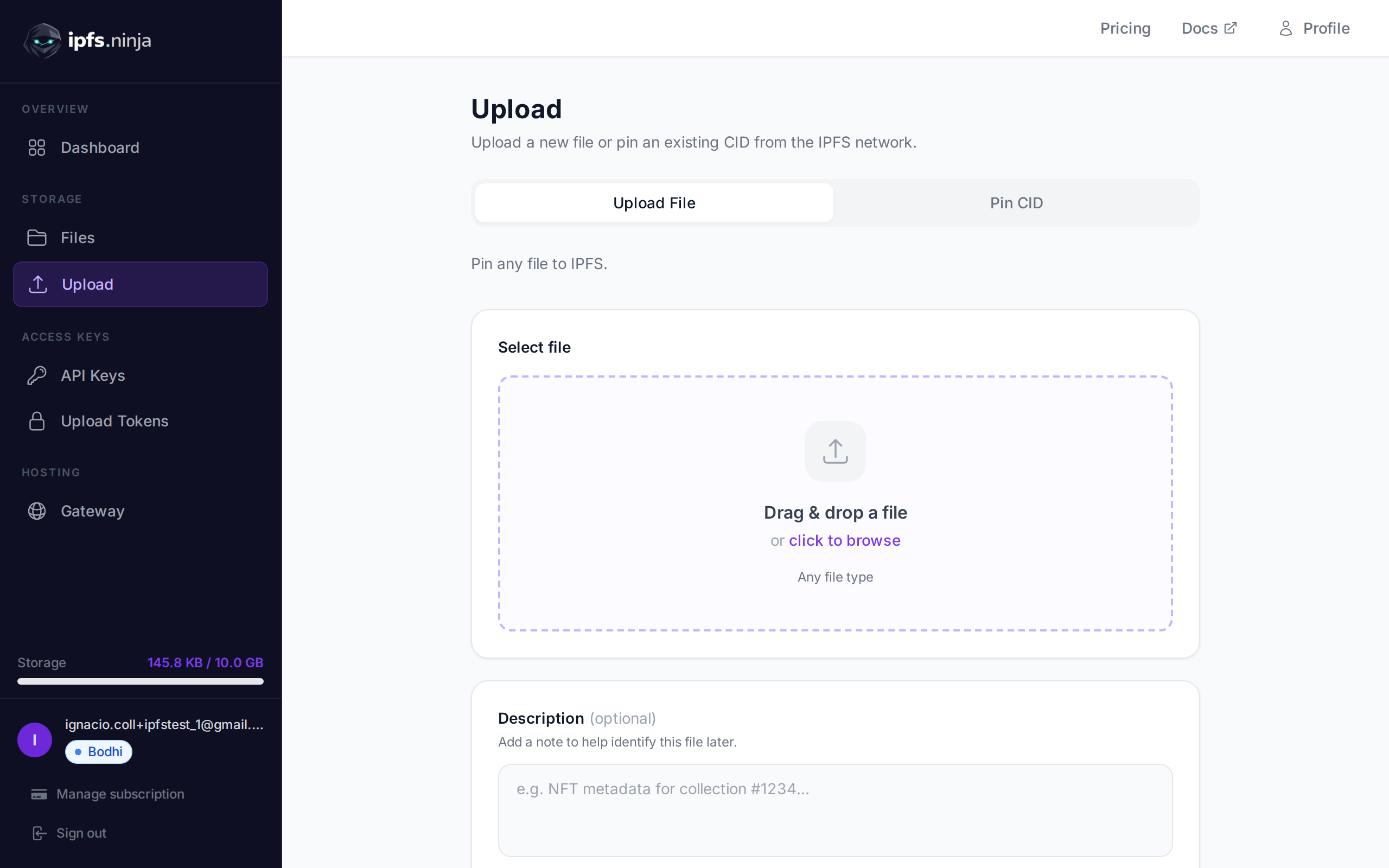
If you'd rather not write code, ipfs.ninja/upload accepts drag-and-drop for:
/ipfs/{cid}/{subpath} for every child file.car archive — auto-detected, root CID preserved exactly (see CAR Import)Once uploaded, files show up on the Files page where you can rename, move between folders, get an IPFS directory CID for a whole folder (snapshot), and configure per-bucket S3 CORS for browser SDK access.