
IPFS vs Arweave: Which Decentralized Storage Should You Choose?
IPFS and Arweave take different approaches to permanent storage. Compare architecture, cost, permanence guarantees, and when to use each.
 by Nacho Coll
Nacho founded IPFS.NINJA to make content-addressed storage feel as simple as an S3 PUT — a single API call, a permanent CID, no wallets or peer discovery to reason about.
IPFS and Arweave solve overlapping problems with opposite economic models. IPFS is a content-addressed transfer protocol — you get a CID that references content, and that content only stays retrievable while some node has it pinned. Arweave is a blockchain-backed storage network — you pay once upfront and a decentralized set of miners are economically incentivized to keep replicating your data indefinitely. Neither is “better” in the abstract; they trade off differently on cost, permanence guarantees, and where the responsibility for keeping your data alive actually sits.
Quick comparison#
| IPFS | Arweave | |
|---|---|---|
| Identifier | CID (content hash) | Transaction ID |
| Persistence model | Only stays available while pinned somewhere | Paid once, replicated by miners long-term |
| Payment model | Recurring (pinning service subscription) | One-time upload fee (in AR tokens) |
| Mutability | Immutable per-CID; new content = new CID | Immutable per-transaction |
| Retrieval | Any IPFS gateway that has the content pinned | Any Arweave gateway |
| Typical cost driver | Ongoing storage + bandwidth | Upfront storage fee, priced in AR at upload time |
| Best fit | Content that’s actively served, updated, or has bounded retention needs | Content meant to outlive the project that created it |
| Getting started | REST API, X-Api-Key auth, works from any origin | Arweave wallet + AR tokens required to pay for uploads |
If you need a one-line rule: use IPFS when you control the pinning lifecycle and want low-friction, low-cost storage for content your app actively serves. Use Arweave when the whole point is that no one — including you — has to keep paying to keep it alive.
Architecture: how each network actually stores your data#
IPFS is a peer-to-peer protocol, not a storage guarantee. When you upload content, it’s hashed into a CID and broken into a Merkle DAG of blocks. Any node that has those blocks can serve them. Nothing about the protocol requires any node to keep a copy — that’s what “pinning” is for. A pinning service like IPFS.NINJA holds a durable copy and serves it over gateways so your content doesn’t silently disappear when nobody happens to be seeding it. Unpinned content gets garbage collected.
Arweave bakes storage into consensus. Miners (“Storage Endowment” participants) are paid from a pool funded by upload fees to keep replicating blockweave data over time. The pitch is “pay once, stored forever” — the upload fee is priced to cover an estimated 200+ years of storage cost, based on a declining storage-cost curve. You don’t manage pinning; the protocol’s incentive design is the persistence mechanism.
The practical difference: on IPFS, you (or a service acting for you) are the reason content stays alive. On Arweave, the network’s economics are the reason. That shifts where the operational risk sits — IPFS risk is “did someone stop pinning this,” Arweave risk is “did the endowment math hold up over decades.”
Cost model: recurring vs. one-time#
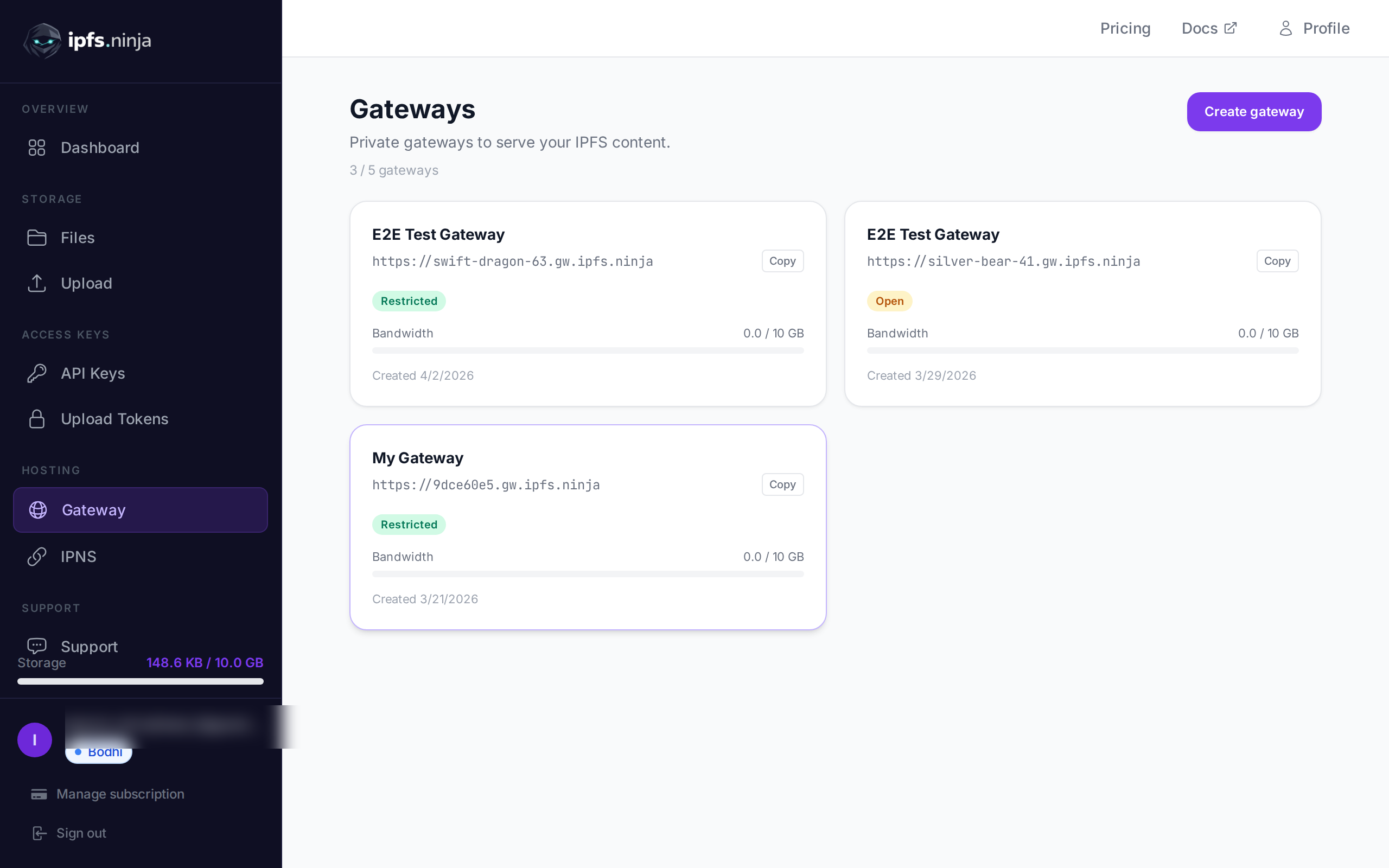
IPFS pinning services charge recurring pricing — you pay for storage and bandwidth you’re actively using, and you can delete or let content expire when you no longer need it. IPFS.NINJA offers a 7-day trial (10 GB / 200 files / 20 GB bandwidth / 1 dedicated gateway, no credit card required) so you can validate the model end-to-end, then paid plans from $5/mo (Bodhi: 10 GB, unlimited files) up through $59/mo (Nirvana: 1 TB storage). That model fits content with a bounded or evolving lifecycle: build artifacts, user uploads, app assets you might replace next quarter.
Arweave charges a single upfront fee per upload, denominated in AR tokens and priced by file size at time of upload. There’s no recurring bill and no way to “cancel” — the fee is the whole transaction. That model fits content where permanence itself is the feature: an artist’s final NFT metadata, an archival dataset, a historical record you want retrievable in 2126 regardless of whether your company still exists.
If your access pattern is “actively serve this to users, update it occasionally, maybe delete it later” — recurring IPFS pinning is cheaper and more flexible. If your access pattern is “write once, needs to survive independent of me” — Arweave’s one-time fee removes the risk of a subscription lapsing.
Permanence guarantees: what “permanent” actually means#
Neither network’s permanence is unconditional — they just fail differently.
- IPFS: your content is exactly as permanent as your pinning arrangement. Stop paying a pinning service, and once they garbage-collect, the CID may become unretrievable unless someone else independently has a copy pinned. This is a feature, not a flaw, for content you don’t want to pay to keep forever.
- Arweave: permanence depends on the storage endowment’s economics continuing to hold, and on enough miners finding it profitable to keep replicating old data as storage costs fall over decades. It’s a strong economic bet, backed by a track record, but it’s a bet on a token economy — not a physical guarantee independent of any system.
Practically: if you need content retrievable next month with zero operational effort, pin it on IPFS. If you need a durable, independently-verifiable public record that should outlast your project, Arweave’s model is purpose-built for that.
Developer experience#
Getting started with IPFS.NINJA is a single authenticated HTTP call — no wallet, no token purchase, no blockchain interaction required:
curl -X POST https://api.ipfs.ninja/upload/new \
  -H "X-Api-Key: bws_a1b2c3d4e5f6a1b2c3d4e5f6a1b2c3d4" \
  -H "Content-Type: application/json" \
  -d '{
    "content": "SGVsbG8sIElQRlMgVnMgQXJ3ZWF2ZSE=",
    "description": "IPFS vs Arweave comparison example"
  }'
const response = await fetch('https://api.ipfs.ninja/upload/new', {
method: 'POST',
headers: {
'X-Api-Key': 'bws_a1b2c3d4e5f6a1b2c3d4e5f6a1b2c3d4',
'Content-Type': 'application/json',
},
body: JSON.stringify({
content: btoa('Hello, IPFS vs Arweave!'),
description: 'IPFS vs Arweave comparison example',
}),
});
const { cid, uris } = await response.json();
console.log(cid, uris.url);
// bafk... , https://ipfs.ninja/ipfs/bafk...Arweave uploads require an Arweave wallet holding AR tokens, and the upload transaction itself needs to be signed and confirmed on-chain before the data is queryable — a heavier integration for teams that just want an HTTP endpoint to POST content to.
If your team is already comfortable with REST APIs and wants to ship today, IPFS’s onboarding friction is close to zero. If your team is already in the Arweave/AR ecosystem (e.g., building on Arweave-native infrastructure), staying native avoids a second system to reason about.
Ecosystem fit#
IPFS is the dominant content-addressing layer for NFT metadata, IPFS-native dApps, decentralized website hosting, and anywhere ipfs:// URIs are the expected format — much of the NFT tooling (tokenURI, marketplaces, wallets) assumes IPFS or HTTP gateway URLs. Arweave has its own strong niche in permanent archival use cases — including some NFT projects that specifically want “pay once, no pinning risk” guarantees for metadata and media.
They’re not mutually exclusive. Some projects use IPFS for actively-served content (fast iteration, cheap updates) and Arweave for the specific artifacts that need to outlive the project.
When to use which#
- Use IPFS.NINJA if you’re serving user uploads, app assets, NFT metadata you might still update, or any content where you want simple REST APIs, dedicated gateways, and predictable recurring pricing.
- Use Arweave if the content is meant to be a permanent, one-time-paid record — final archival snapshots, historical documents, or metadata for a project that’s explicitly optimizing for “still retrievable in decades, independent of any ongoing subscription.”
- Use both if you want fast, cheap, flexible serving today (IPFS) plus a permanent archival copy of the final state (Arweave) for the artifacts that matter most.
For the IPFS side of that stack, see our guide on how signed upload tokens work for secure client-side uploads and the full IPFS upload API tutorial for endpoint details.
Ready to start pinning? Start your 7-day trial — 10 GB / 200 files / 20 GB bandwidth / 1 dedicated gateway (trial file cap — Bodhi lifts to unlimited). No credit card required. Then Bodhi $5/mo, Karma $19/mo, or Nirvana $59/mo.
About this article: This article was drafted by an AI assistant using IPFS.NINJA’s content generation workflow, then reviewed and approved by Nacho Coll. All code examples were verified against the live IPFS.NINJA API. If you spot an inaccuracy, please open an issue at https://github.com/ipfs-ninja/feedback. Read more about how we use AI in our content and meet the people behind IPFS.NINJA.
About the author
Nacho Coll
Founder & Engineer at IPFS.NINJA
Nacho founded IPFS.NINJA to make content-addressed storage feel as simple as an S3 PUT — a single API call, a permanent CID, no wallets or peer discovery to reason about. Writes about IPFS internals, decentralized storage patterns, and the pinning-service landscape from the operator side of the wire.